Which is Better: Ryzen or Intel for Gaming?
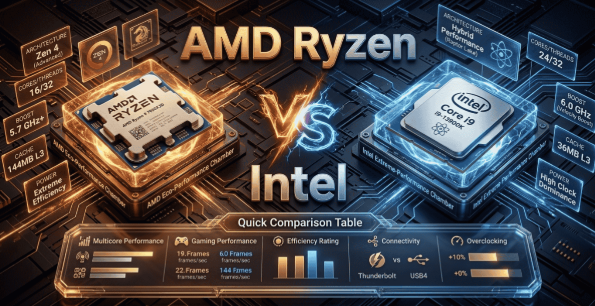
Picking between Ryzen vs Intel is still the first fight every PC builder faces in 2026. Both brands push out strong chips every year, and the gap keeps shifting depending on what you actually do with your machine. This guide breaks down the AMD vs Intel CPU debate across gaming, editing, power draw, and price so you land on the right pick without guesswork.
Ryzen vs Intel: The Quick Answer
If you are building a computer for gaming, the AMD X3D lineup is usually the best choice. Ryzen chips, like the Ryzen 7 9800X3D, have a large amount of L3 cache, which helps reduce stuttering in games that are heavily CPU-dependent. Intel is still better for some applications that rely on higher clock speeds, such as certain creator tools and older game engines.
When people ask "Which is better, Intel or AMD?", the answer depends on what you want to use your computer for, not on brand loyalty. Before buying your parts, it's a good idea to test your chosen processor and graphics card with a Bottleneck Calculator. A weak GPU paired with a powerful CPU can limit gaming performance, making the processor appear slower than it actually is.
Overall, the AMD X3D lineup, especially processors like the Ryzen 7 9800X3D, offers the best gaming performance for most players. Intel remains an excellent option for certain productivity workloads and applications that benefit from higher clock speeds.
AMD vs Intel CPU Comparison at a Glance
| Category | AMD Ryzen | Intel Core |
|---|---|---|
| Gaming (1080p) | Leads most titles via 3D V-Cache. | Competitive in single-thread-heavy esports. |
| Power Draw | Roughly 65–120W under gaming load. | Often 200–250W on K-series flagships. |
| Multi-Core Work | Strong throughput per watt. | Hybrid P-core/E-core helps multitasking. |
| Platform Longevity | AM5 supports newer processor generations. | Socket changes happen more frequently. |
| Price-to-Performance | Better value in the mid-range. | Competitive at select price tiers. |
This table gives you the computer processor comparison Intel vs AMD snapshot most builders search for before checking model-specific numbers.
Is AMD or Intel Better for Gaming in 2026?
For Intel vs AMD for gaming, the short version is that AMD currently holds the edge in raw frame rates. The Ryzen 9 9950X3D pulls ahead of Intel's Core Ultra 9 285K in aggregate benchmark scores, and X3D chips consistently lead gaming charts by double-digit percentages in CPU-bound titles.
Ryzen vs Intel Core for 1080p and Esports
At 1080p, where the CPU has a greater impact on performance than the GPU, cache-heavy Ryzen processors pull noticeably ahead. Intel narrows the gap in fast-paced esports titles such as Valorant and Counter-Strike 2 (CS2), where high single-core clock speeds still matter.
If competitive FPS gaming is your priority, check your target frame rate with our FPS Calculator before choosing a processor. Your monitor's refresh rate plays a major role in determining which CPU tier makes the most sense.
Does It Matter at 1440p or 4K?
Not as much. Once you move to 1440p or 4K, the graphics card becomes the bottleneck for most gaming PCs. That means the AMD vs Intel CPU for gaming decision has less impact at higher resolutions unless you're pairing a flagship GPU with a mid-range processor.
AMD Processors Compared to Intel Processors: Power and Heat

Ryzen processors generally run cooler under sustained workloads. Intel's K-series flagship CPUs can draw well over twice the power of a well-tuned Ryzen 7 during gaming, resulting in louder cooling systems and higher electricity costs over time. If you value a quiet and power-efficient PC, this is one area where AMD processors vs Intel processors is no longer a close competition.
Ryzen vs Intel Core: Mid-Range to Flagship Breakdown
Comparing Ryzen vs Intel CPU models tier by tier is much more useful than making a broad brand recommendation.
- Ryzen 5 vs Core i5: Nearly identical gaming FPS in most titles, with AMD leading in cache-sensitive games and Intel holding a slight advantage in bursty, single-threaded workloads.
- Ryzen 7 vs Core i7: AMD's X3D processors dominate pure gaming benchmarks, while Intel's hybrid architecture performs well when gaming and streaming simultaneously.
- Ryzen 9 vs Core i9 / Core Ultra 9: Both exchange victories in productivity applications, but AMD's large cache gives it the advantage in gaming-focused systems.
Intel Advantages Worth Knowing
Intel or AMD for gaming is not a one-sided decision. Intel's Quick Sync technology accelerates video encoding in applications like Adobe Premiere Pro, while its Efficient Cores (E-cores) handle background tasks effectively. If your PC is used for both gaming and demanding creative workloads, Intel's hybrid design remains an excellent choice.
Which Is Better, Ryzen or Intel? A Budget-Based Answer
Which is better, Ryzen or Intel? The answer depends mainly on your budget and how you use your PC.
- Tight budget, gaming only: Ryzen 5 or Core i5 delivers very similar gaming performance.
- Competitive high-FPS gaming: AMD's X3D processors offer the best frame-time consistency and gaming performance.
- Gaming plus content creation: Ryzen 7, Ryzen 9, or Intel's Core Ultra processors are all strong options.
- Heavy multitasking and rendering: Intel's higher thread counts can provide a small advantage in certain professional workloads.
Wrapping Up
The Ryzen versus Intel debate has no universal winner in 2026. AMD currently leads gaming benchmarks while offering better power efficiency, whereas Intel continues to perform exceptionally well in creator-focused applications and hybrid multitasking workloads.
For most gaming PCs, AMD's X3D lineup provides the best gaming performance for the money. Intel remains a strong choice if your workload combines gaming with video editing, rendering, or other demanding productivity tasks.
Whichever processor you choose, make sure your entire PC is well balanced before buying. Our FPS Calculator and Bottleneck Calculator can help verify that your CPU, GPU, and target resolution are matched for the best possible performance.
FAQs
Is Ryzen better than Intel for gaming?
Yes, in most 2026 gaming benchmarks. AMD's X3D processors lead frame rates in CPU-bound games thanks to their large L3 cache, which improves gaming performance and frame-time consistency.
Is Intel better than AMD for productivity?
Intel can have an advantage in productivity workloads, especially in creator applications like Adobe Premiere Pro, where Quick Sync accelerates video encoding. Its hybrid architecture also performs well during multitasking.
What Intel processor compares to Ryzen 7?
The Core Ultra 7 265K and Core i7-14700K are the closest Intel processors to Ryzen 7 X3D models in terms of overall performance.
Does CPU choice matter at 4K gaming?
Not as much as it does at 1080p. At 4K resolution, the graphics card becomes the primary bottleneck in most gaming systems, reducing the impact of CPU differences.
Which uses less power, Ryzen or Intel?
Ryzen processors generally consume less power during gaming workloads. Many Ryzen gaming CPUs draw roughly half the power of Intel's flagship K-series processors under similar conditions.
Is Ryzen 7 better than i7?
For gaming, Ryzen 7 X3D models, such as the Ryzen 7 7800X3D, typically outperform Intel Core i7 processors in average FPS and frame-time consistency. In heavily multi-threaded productivity workloads, some Core i7 models can match or slightly outperform Ryzen 7, depending on the processor generation.
Is Ryzen 5 equal to the i7?
No. Ryzen 5 belongs to the mid-range segment, while Intel Core i7 targets a higher performance tier with more cores, threads, and stronger multi-core capabilities. Although Ryzen 5 processors can compete with some i7 models in gaming, the i7 generally remains the better choice for demanding productivity tasks.
Is Ryzen 7 equal to i5 or i7?
Ryzen 7 competes directly with Intel Core i7, not the Core i5. Both target a similar price range and performance level, while Core i5 processors are generally positioned against Ryzen 5 models.
Ryzen vs Intel Price Comparison
AMD Ryzen processors offer excellent value across nearly every price segment. At the high end, the Ryzen 7 9800X3D costs around $480 yet delivers better gaming performance than Intel's Core Ultra 9 285K, which costs approximately $630. That gives AMD a significant gaming advantage while costing about $150 less.
In the mid-range market, processors such as the Ryzen 5 9600X, priced around $189, often provide better gaming performance per dollar than comparable Core Ultra 5 processors, which typically sell for around $250.
Intel becomes more competitive in the upper mid-range, where chips like the Core Ultra 7 265K can cost less than some Ryzen 9 models while still delivering excellent gaming and productivity performance.
Overall, AMD currently provides the strongest price-to-performance ratio for gaming-focused PCs, while Intel justifies its higher prices for users who regularly perform demanding multi-threaded workloads such as video editing, rendering, and software development.