Picking an internet plan usually comes down to one confusing number on a page. You spot "150 Mbps" and have no real way to tell if that's plenty or barely enough. Choose too little, and your video calls freeze at the worst possible moment. Choose too much, and you're paying every month for speed you'll never use.
So, is 150 Mbps good? Here's a straight answer, built around what streaming, gaming, and remote work actually require.
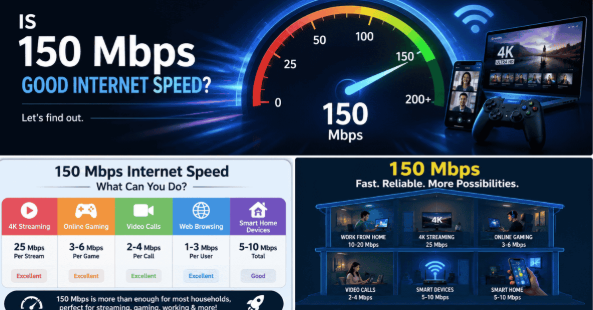
Quick answer: For most households of two to four people, 150 Mbps is good. It handles HD and 4K streaming, video calls, and everyday work-from-home tasks with room to spare. Bigger households or homes with serious gamers and heavy downloaders often want more.
Table of Contents
- What Does 150 Mbps Actually Mean?
- Is 150 Mbps Good for Streaming?
- Is 150 Mbps Fast Enough for Gaming?
- Is 150 Mbps Good for Working From Home?
- How Many Devices Can 150 Mbps Handle?
- 150 Mbps vs Other Internet Speeds
- Signs You Might Need More Than 150 Mbps
- Getting the Most Out of Your Connection
- FAQs
What Does 150 Mbps Actually Mean?
Mbps stands for megabits per second, and it measures how much data your connection can pull in every second. That speed works out to roughly 18.75 megabytes per second, since there are 8 bits in a byte. That's fast enough to pull down a 5GB HD movie in under five minutes under ideal conditions.
One detail trips people up constantly. This speed you see advertised is almost always your download speed, not your upload speed. Cable plans in particular often pair this network down with a much smaller upload, sometimes just 10 to 20 speed. If you send large files or host video calls often, check that upload number too, not just the headline figure.
Is 150 Mbps Good for Streaming?
Yes, comfortably. Netflix recommends around 5 Mbps for HD and roughly 15 Mbps per stream for 4K Ultra HD, and Amazon Prime Video and Disney+ ask for similar numbers. On a 150 speed connection, you could technically run several 4K streams across different rooms at once and still have bandwidth left over.
In practice, most homes never come close to that ceiling. A single household watching one or two shows in HD or 4K, while someone else browses or scrolls social media, barely dents the broadband plan. Buffering on a connection this fast almost always traces back to your wifi router or a weak signal, not the plan itself.
Is 150 Mbps Fast Enough for Gaming?
For most players, yes. Actual gameplay is surprisingly light on bandwidth, needing only around 3 to 6 Mbps according to guidance from Xbox, PlayStation, and Nintendo. What matters far more for gaming is latency, or ping, since a laggy connection ruins a match long before a slow download speed does.
Where the 150 download rate genuinely helps is downloading the games themselves. Want to know how long a 50GB, 100GB, or larger game will take to download? Use our Download Time Calculator to get a quick estimate based on your internet speed.
Modern titles often run 50GB to 150GB per update, and at 150 network speed you're looking at roughly 90 minutes for a 100GB download instead of several hours on a slower plan. If multiple people in your house game and stream large downloads at the same time, that shared bandwidth can get tight fast.
Is 150 Mbps Good for Working From Home?
Yes, most of the time. When you work from home and use the internet for things like email, cloud file syncing and VPN access it usually uses between 5 and 25 networks. This is within what most plans offer. Video calls can use a lot of data. Even if you are using Zoom with a lot of people and it is in 1080p HD it still only uses less than 4 Mbps of upload per person.
The upload speed is what you should really check before you think that 150 Mbps is good for working from home. If your internet plan has 150 Mbps download but the upload speed is slow and two people are on video calls at the time the internet can get slow. If you have a fiber connection with the upload and download speed you do not have to worry about this problem. Fiber connections with speeds are really good for remote work like video calls. Remote work, with fiber connections is very reliable.
How Many Devices Can 150 Mbps Handle?
There is no hard limit, as it really depends on the device and what you want to do. For example, a smart lightbulb and a 4K stream require vastly different bandwidth usage. As a general rule of thumb, most companies would say that 150 Mbps is enough for up to four users to use the Internet for browsing, streaming, calling, and playing games at once.
Here is an example of such usage for a three-person family:
- Up to two simultaneous HD or 4K streams: about 20-30 Mbps
- Videoconferencing from work: about 4 Mbps
- Online games: about 5 Mbps
- Other devices (smart speakers, smartphones): about 10 Mbps
And you still use less than half of your plan at that.
150 Mbps vs Other Internet Speeds
Numbers mean more with something to measure them against. Here's how a 150 Mbps internet speed stacks up next to the other common speed tiers you'll see listed on provider websites.
| Speed | Best For | Typical Household |
|---|---|---|
| 100 Mbps | Browsing, HD streaming, one video call at a time | 1 to 2 people, light use |
| 150 Mbps | HD and 4K streaming, video calls, WFH, casual gaming | 2 to 4 people, moderate use |
| 200 Mbps | Multiple 4K streams plus heavier multitasking | 3 to 5 people |
| 300 to 500 Mbps | Big households, frequent large downloads, multiple gamers | 5 or more people, heavy use |
| 1 Gbps and up | Content creators, smart-home heavy setups, power users | Large or high-demand households |
Signs You Might Need More Than 150 Mbps
150 Mbps becomes insufficient only when the actual usage from your house exceeds that limit, regardless of any strict standards. Pay attention to buffering when multiple individuals use the connection, poor quality of video conferencing calls during the evening hours, or excessively long file downloads.
Several scenarios will lead you to consider an upgrade to 150 Mbps sooner rather than later: at least five members of your family using the internet intensively, two or more persons playing games or watching movies in 4K quality at the same time, or large file uploads on a regular basis. In case two or three of those scenarios apply to your household, you should think about 300 Mbps or more.
Getting the Most Out of Your Connection
A few habits make this plan feel noticeably faster without upgrading anything. Connect your bandwidth hungry devices (a gaming console, or a smart TV, a work laptop etc.) directly with an ethernet cable when you can, since wifi always loses some speed to interference and distance.
Also worth checking your router's age and wifi standard. A router older than five years, or one running on the 2.4GHz band alone will bottleneck the connection badly even though the plan itself is fine. Upgrading to a modern wifi 6 router often does more for everyday speed than upgrading your internet plan would.
FAQs
Is 150 Mbps good for streaming in 4K?
Yes. Most 4K streams need about 15 Mbps, so 150 Mbps supports several at once with room left over.
Is 150 Mbps fast enough for online gaming?
Yes, for gameplay itself. Latency matters more than speed, though big game downloads go noticeably faster at 150 Mbps.
Is 150 Mbps good for working from home?
Yes, for most remote work setups, though it's worth checking your upload speed if you're often on video calls.
How many devices is 150 Mbps good for?
Most households can comfortably run several devices at once, generally enough for two to four people with mixed daily use.
Is 150 Mbps fast for internet?
Yes. It sits well above the FCC's 100 Mbps broadband benchmark and covers nearly all everyday household needs.
Is 150 Mbps better than 100 Mbps?
It's noticeably more headroom, which matters most once a second or third person starts streaming, gaming, or calling at the same time.
How many devices is 150 Mbps good for?
Yes, 150 Mbps is fast for 2 people, easily supporting simultaneous HD streaming, remote work video calls, and online gaming.
Conclusion
So, is 150 Mbps good? For the average household of two to four people, yes, it comfortably covers HD and 4K streaming, video calls, remote work, and casual gaming with room left over. It only starts to feel tight in bigger homes with several heavy users running demanding tasks at once, or when upload speed rather than download speed becomes the real bottleneck. Before you upgrade or downgrade a plan, it's worth running a quick speed test and counting how many people in your home are actually online at the same time, since that number matters more than the plan name on the bill.